|
 |
 |
 |
||||||||||||||||||||||||||||||||||||||||||||||||||||||||||||||||||||||||||||||||||||||||||||||||||
Why Expertize? >Why Expertize?By Larry Lyons There are many reasons why you should get your stamps and covers expertized. This educational message will explore the why, what and how about philatelic expertization. This program is brought to you by the Philatelic Foundation, a not-for-profit corporation founded in 1945 dedicated to education in philately. The Philatelic Foundation, or PF for short, expertizes stamps and covers. Why expertize?The obtaining of a certificate from the expertization process is an assurance as to the condition, quality, and genuineness of a philatelic item based on it being “reviewed” by at least three philatelic experts. The “certificate” may implicitly suggest an acknowledgement to collectors, dealers and auction houses that this item is the real “cookie” and may be “special” or “valuable.” Most higher quality or higher value stamps and covers should have a PF certificate, otherwise it is “buyer beware” and “buyer could be sorry.” It is usually understood that a stamp or cover accompanied by a PF certificate, which is less than five years old, should not be returned except for extenuating circumstances. This rule is usually found in the “conditions of sale” included with every auction catalogue. So the “certificate” gives the stamp or cover a “respected blessing” by nature of its having been carefully examined by philatelic experts who do this for a living. It also may have been reviewed by “consultants” whose opinions are recognized as being highly respected in the philatelic community. There is always the human element that mistakes can be made and new information or new standards could result in a change of opinion, but for most cases the certificate will be correct. The value of the item will depend on what is stated in the certificate. For instance, a stamp which appears to be an unused ten-cent 1847, Scott number 2 may not be worth anything close to its Scott Catalogue value of $35,000.00 especially if it is certified as a used example with a removed cancellation, re-gummed, with a repaired tear and a filled thin. A U.S. #2 with this on its certificate would most certainly be worth less than $100.00.
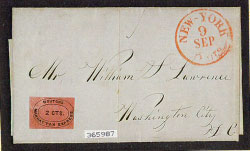
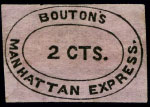
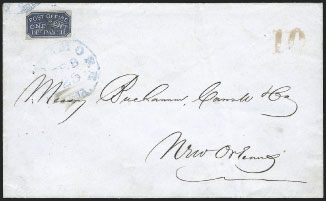
Below is a local post stamp, 17L1 with a catalogue value of $4500.00 on cover and a value of $900.00 for an off cover stamp that is cut to shape. If it is certified as a counterfeit or forgery it is worth about $2.00.
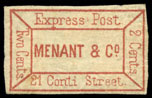
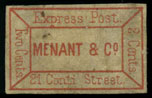
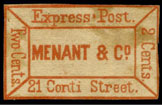
Here is a genuine local post Menant & Co.’s Express stamp issued in New Orleans in 1853 along with a forgery of the same stamp. Can you tell which is genuine? If you used an old Scott CataloguePre-1988 you could have chosen the forgery as the genuine stamp.
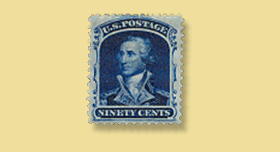
Below is a ninety-cent early U.S. stamp. The Scott Catalogue Identifier leads you to the conclusion that you may have a U.S. #39 from 1860 which has a Scott Catalogue value of $10,000.00 or it could be a U.S. #47 which is not known used and has an unused value of $4,500.00. The 2011 Scott Specialized Catalogue has a note under the listing for the U.S. #39 which says “all used examples of the No. 39 must be accompanied by certificates of authenticity issued by a recognized expertizing committee.” The reason for this note is the preponderance of U.S. #39 stamps with counterfeit cancels and/or alterations or faults. The alterations and faults will significantly affect the value of the stamp. Needless to say a counterfeit marking is not in the least desirable.
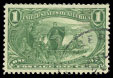
Let’s look at a stamp with a Catalogue value of about $200.00, which the collector may easily encounter. Each collector will have their own “threshold for pain or disappointment” and “$200.00 is a good level at which to draw the line. The auction houses usually will not accept a consignment containing items with a lot value of less than $200.00. This is not the Scott value.
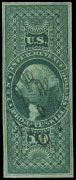
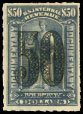
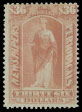
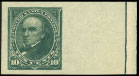
See answers below. Let’s look at some U.S. revenue stamps. The stamps I have chosen to show you have the appearance of being R96a, RO63d and R194. Are they good?
What Can You Expect on the Certificate?Suppose you have what appears to be a used stamp and you believe the cancel is genuine. The certificate will first tell you if in the opinion of the PF experts you have the correct Scott Catalogue number. It will then tell you if the experts believe the cancel is genuine. It will next list any and all of the faults the experts found, such as:
If the submission is an unused stamp the certificate will also evaluate the gum and possible state some of the following condition opinions:
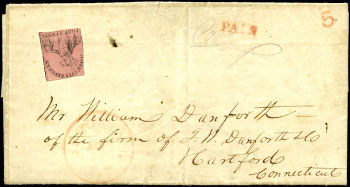
If the submission is a cover the certificate will address the stamps on the cover, the indicia, the frank, the cancellations and the markings. Examples of opinions given on covers include the following:
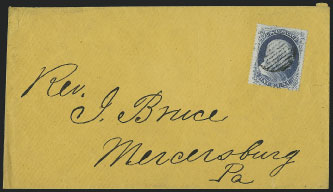
Special Certification ServicesTrends change from time to time and certifications change to reflect these trends. For instance it was customary prior to August 1993 to state than an unused stamp had “original gum” without mention if the stamp was “never hinged.” As the collecting public turned to wanting the best stamps possible with respect to gum it became necessary to have “never hinged” certification . This has been interpreted as “pristine” without a blemish visible under magnification and without any gum defects or redistribution. The Scott Specialized Catalogue moved to providing prices for unused stamps which have “no gum” as well as those that are “never hinged.” There is no additional charge from the PF for the service of reviewing the gum on the back of the stamp. A Stamp reviewed in the 1970s for gum quality would not be looked at the same way today. Beginning in late 2001 a system of stamp grading began. This evaluation gives a numerical grade to a stamp based on its centering. This grade is issue sensitive. The Philatelic Foundation has a grading manual available on request to explain how this works. The PF does not grade stamps with faults or flaws. There is no charge for this service. Do Opinions Change?Yes they do, and this may be a little difficult to comprehend. There are two areas where the most changes have occurred. The two areas which contain the most opinion changes are both due to a much higher degree of scrutiny applied currently as compared to ten years ago. With respect to ”never hinged” gum and stamp perforations, minute gum “enhancement” will show itself in a slight discoloration over time but can be very difficult to detect. Each time a stamp is certified the submitter receives the honest opinion of the expertizers. Prior opinions are reviewed but can be reversed based on what can currently be detected using possibly more advanced techniques and equipment not available years ago. Equally as troublesome are stamp perforations or more importantly stamps being reperforated on very sophisticated machinery. Again, this may be very difficult to detect and the experts look closely at every perforation on a stamp. This scrutiny, coupled with newer, more advanced gauges has led to some reversal of early opinions. Occasionally new faults are found on stamps with prior certificates. These faults could be new or were not detected earlier. Again, the new opinion is rendered based on today’s analysis, today’s conventions and the level of scrutiny now being applied Who Should Get Certificates?Cover Collectors Postal history is the study of covers or folded letters. These letters or folded sheets can involve stamps, cancellations, postal stationary, rare markings, franks, manuscript markings, or stampless mail. It involves mail from colonial times through modern times. A submitted item may require knowledge in some or most of the categories just mentioned. It is quite likely that even an advanced collector will not be strong in every category and could make a mistake which could be costly at a later date. The key is to certify! Get a certificate which supports your own conclusions but enhances and helps with the eventual sale of each and every valuable item. There is always the possibility the present owner will not be alive at the time of sale and the certificates will speak up for the deceased. Do not deceive yourself with the thought that the item you have does not need a certificate. Here are some examples which reinforce my point.
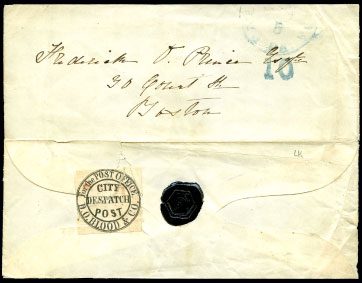
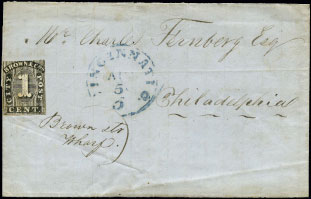
Local Post Collectors A great many covers with local and carrier stamps on them do not have tying cancels. The experts have techniques which reveal if the adhesive has been on the cover a long time. They also examine the cover markings and examine the letter contents. They look at references, usage periods, provenance and prior opinions. The Scott Specialized Catalogue has listings for stamps on cover, not tied, with certificates. There are similar listings for adhesives which are manuscript tied with certificates. The carrier and locals field has an enormous amount of fakes, reprints and counterfeits. The PF has an extensive reference collection. An expert in the field is on staff. Many local stamps are valuable with a high percentage of the stamps having a Scott Catalogue value of $200.00 to many thousands of dollars. It is not uncommon for collectors to find genuine stamps in forgery collections. Collectors should separate their genuine stamps from their forgeries. One way of doing this is to have a PF certificate for each and every genuine stamp. This will be of great value when it comes time to sell your collection. If the collection goes to your heirs they will not know the genuine stamps from the forgeries. Do not let your collection become the one with genuine stamps mixed in with forgeries and sold as a forgery collection. Get your stamps and covers certified by the Philatelic Foundation!
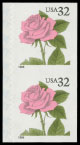
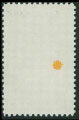
EFO Collectors Collectors of errors, freaks and oddities see stamps with colors missing, pre-printed paper folds, colors not known on the issued stamps and misperfing errors. The key question is “are these stamps exhibiting these errors as a result of an original printing malfunction?” The PF experts can tell you if a stamp has been chemically altered or subjected to other manipulations to attract your attention and your dollars. The rule might be that a color must be entirely missing from a stamp. Some stamps have remnants of the missing color and do not qualify as the special “color missing” variety. For example see the Scott Catalogue comments under 1488b. If a stamp is valuable it should have a PF certificate attesting to its genuineness. Here is an example submitted as 2492h.
Postal Stationery Collectors
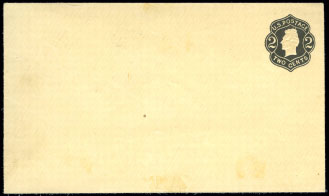
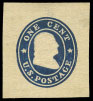
See answers below Postal Stationery collectors are urged to use the PF certification services. The PF has an extensive reference collection in this area. The reference collection is helpful for special types, special colors and overprints. The experts also can detect portions of indicias colored in and repairs made to envelopes. PF certification of valuable items is a must! Again, if your threshold for pain and loss is $200.00 then you should get a PF certificate for every item valued over that amount. Here are some examples which were submitted as a U48 entire, U66 a cut square, W25 a wrapper, and U82a an unlisted item.
Expert Collectors Every major collector and postal historian has been fooled at one time or another. It’s a sad commentary but an accurate one. It comes along part and parcel with being a collector and expert collectors are not immune. On the bright side, expert collectors can spot superior quality stamps and covers. These items should be certified by the PF to attest and reaffirm the beliefs of the expert collector. Expert collectors have valuable items and by their nature these stamps and covers should have certificates. It is no surprise that most of the higher priced stamps and virtually all of the postal history items come to the PF for certification. Based on the value of the stamps and covers submitted, the PF is by far the leading expertizing service, year in and year out. It is important to recertify stamps and covers which already have certificates. The general rule is every five years. Most auction houses allow items to be resubmitted if the item has a certificate which is more than five years old. Trends and focus do change. You now should have a graded certificate on a well centered stamp with no faults, which received a PF certificate before grading was started. Similarly this applies to never hinged stamps with certificates issued prior to the modern focus on the condition of the gum on the back of the stamp. Many major philatelic pieces receive certificates with special certificate numbers such as even “ten thousands” or exact “hundred thousand” certificate numbers. Here are a few examples.
Foreign Stamp Collectors The Philatelic Foundation has an extensive reference collection of foreign stamps. The PF also consults with major collectors and experts around the world. Why use the PF instead of a foreign expertizing service? The answer is simple. A PF certificate has a greater status and is more recognized than those of any other service. There is also a second reason. The stamps receive the scrutiny of the PF expertizing staff which is the world leader in the detection of thins, reperforating, regumming and other stamp faults and human manipulations. Here are some examples.
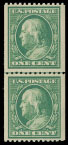
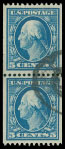
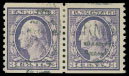
Washington-Franklin Collectors The Scott Specialized Catalogue has an extensive identifier for the Washington-Franklin stamps. This identification is based on the identification of watermarks, perforation measurements, and printing methods such as offset, flat plate and rotary press. Let’s not forget the various types which can be difficult to identify and can number as many as nine for a single issue. It’s a fine line between a valuable stamp and one worth only a dollar or less. Misidentification is commonly found. You need to get Washington-Franklin stamps certified by the Philatelic Foundation! The issued certificate will provide the correct Scott Catalogue number if you have misidentified your stamp. Sometimes this is a change to a more valuable Scott Catalogued item! The PF experts handle hundreds of these stamps every month. Besides being experts at identification you get a certification on the quality of the stamp and a grade if requested; only if the stamp has no faults. Certification by the PF is a must! Here are some examples.
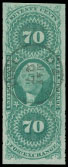
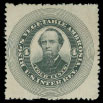
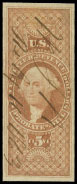
Revenue Collectors In the revenue stamp section of the Scott Specialized Catalogue one usually finds a substantial difference in price between stamps which are fully perforated, part perforated, and imperforate stamps. There are also valuable stamps with double transfers, stamps with inverted centers, and stamps with sewing machine perforations. Much tomfoolery comes into play here. As with U.S. Classic stamps condition matters and usually thins and tears greatly decrease the value of the stamp. The Philatelic Foundation has a world-class revenue stamp collector on staff. The PF experts are tuned to knowing all of the sly pitfalls mentioned above and it is advantageous to obtain a Philatelic Foundation certificate to attest to the genuineness of a revenue stamp. The certificate will be useful and financially beneficial when it becomes time to sell. You need to protect your valuable revenue stamps with PF certificates. Here are a few examples.
Beginner-Neophyte Collectors Where do you get your stamps? A usual answer is “from a stamp dealer.” It is probably fair to say that many stamp dealers are not sufficiently knowledgeable in all areas of philately. Most dealers probably have honest intentions but there is great room for error. Collecting stamps is easy, knowing what you have can require lots of study and knowledge. If you are collecting stamps with low cost, little harm can happen. Eventually you will fill those blanks and move up to stamps costing $75.00 to $100.00 or more. Since stamp collecting is a long-term hobby it is possible that these stamps may be worth over $200.00 a decade from now. Planning now can avoid disappointment later so it is recommended you get your best stamps, of high quality, certified. The PF certificate will let you know if you stamp purchase has any faults. Stamps with PF certificates are returnable if the stamp was sold to you without identifying the faults shown on the certificate. So getting a stamp or cover certified is a win-win situation. You win by being able to return it now due to faults and you win later by having a certified stamp which can be sold with recognized assurance. A regular plan to submit stamps and covers as your acquire them is recommended. It is important to understand some of the fee terms which will affect you. First, if a stamp is found to be misidentified by the submitter who named the wrong catalogue number for the stamp, the fee will be based on the value of the correctly identified stamp. Also, the fee for counterfeits and forgeries will be the minimum $27.00 charge for stamps and $40.00 for a cover. If after deliberate consideration the expert committee is unable to issue an opinion regarding the authenticity of any submitted item, it will issue a “no opinion” certificate for which the minimum fee of will be charged. This will most likely occur only if the experts cannot determine if a stamp originated on a cover. For certificate fees and special services see the back of the submission form where you will find a special supersaver rate of $20.00 for a select group of U.S. and Canadian stamps with a submitted value of $100.00 or less. Let’s look at some examples of what you might find.
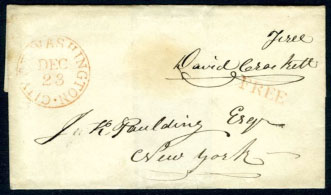
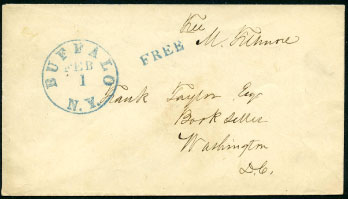
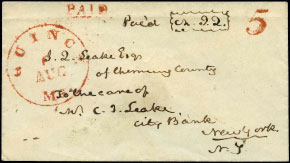
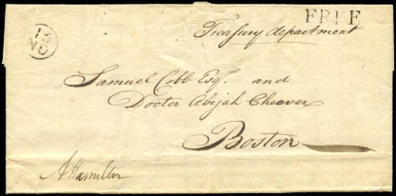
Free Frank Collectors The Philatelic Foundation certifies Free Franks of famous people by comparison with examples that are known to be genuine. Sometimes they can tell you if the Free Frank is written in the hand of the famous person’s secretary. Here are some examples, one of which is not genuine!
Advanced Collectors Stamp collecting is an enjoyable hobby. You don’t want to get to the point where you are heavily invested and your stamps and covers are not certified. If this happens you almost certainly will be disappointed when it is time to sell. The detection of thins, tiny tears, filled thins, regumming and other small faults is a science and requires lots of study, experience and ability. It is best left to the experts at the Philatelic Foundation who do this day-in and day-out. A “clean” PF certificate which does not note any faults is a valuable document when it comes time to sell. If you have kept up with getting your stamps and covers certified and a great number of years has gone by since you started collecting, it is highly recommended that you review your collection to submit for certification those stamps and covers which have grown in value since you acquired them. If a stamp or cover is now worth over $200.00 it is beneficial to obtain a PF certificate to protect your investment for its eventual resale. As an advanced collector you will have valuable and possibly rare stamps and covers. Your holdings will require certificates for their eventual resale so review your collection now and send those stamps and covers to the Philatelic Foundation. It is important to know that some additional services are available to you. The PF will honor requests for plating, when possible, for an additional fee of $25.00. Duplicate certificates for certified multiples are available at $6.00 each but only if the request is made at the time of submission. Individual stamps from a previously certified multiple are eligible for separate certificates provided the multiple is “broken” in the presence of a member of the Expert Committee. The fee for each separate certificate is $15.00 per stamp. Let’s look at a few examples.
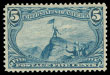
Rare Stamp Collectors Virtually all rare stamps are accompanied by a Philatelic Foundation certificate when brought to market for sale. This is true for dealers selling rare stamps as well as auction houses. The PF is a not-for-profit tax exempt organization which was found in 1945. Certificates issued by the PF are the most highly respected means of certification available. The Philatelic Foundation is a public service which expresses the opinions of its staff and knowledgeable collectors and professional consultants who serve as members of their expert committee. The PF does not have a financial interest in the stamps and covers they certify so you should submit your rare stamps to the PF with knowledge that you will get the best evaluation possible. If you request grading you will get an honest evaluation not one which will please you now but disappoint you when it comes time to sell. If you are a dealer you will best serve your clientele by obtaining PF certificates for the stamps and covers you sell. If you are talking rare stamps and covers you are talking about PF certificates—these are synonymous like apple pie and ice cream. Let’s take a look at a few examples of rare stamps with certificates.
Dealers It is a proven fact that stamps and covers sell better and at higher prices when accompanied by a Philatelic Foundation certificate. Certificates accompanying stamps and coves prevent returns for condition faults. Dealers with integrity and professionalism certify their stamps and covers at the Philatelic Foundation. Your clientele buys with more confidence when your stamps and covers have PF certificates. Priority and express services are available. See the back of the submission forms. A high-volume discount program is also available. Contact the Philatelic Foundation office for details. Also duplicate certificates for certified multiples are available at $6.00 each if the request is made at the time of submission. Individual stamps from a previously certified multiple are eligible for separate certificates provided the multiple is broken in the presence of a member of the Expert Committee. The fee for each separate certificate is $15.00 per stamp. Here are a couple of examples of dealer certified stamps and covers. Some dealers advertise that each of their rare stamps for sale has a Philatelic Foundation certificate because “a PF cert gives you peace of mind.”
Graded Stamps There is no charge for the grading of a stamp. The Philatelic Foundation will not issue a grade on a stamp with faults. You can request a grade be given if only above a number you specify, such as 85. The Philatelic Foundation will place an “XQ” after a grade if the stamp is of exceptional quality. The grading is a centering and freshness comparison to similar stamps of the same issue. Which of these would you give a 95?
Services AvailableStandard Service
|
||||||||||||||||||||||||||||||||||||||||||||||||||||||||||||||||||||||||||||||||||||||||||||||||||
The Philatelic Foundation is located at 341 West 38th Street, 5th Floor, New York, NY 10018 Copyright 2005 - by The Philatelic Foundation, all rights reserved.
|
||||||||||||||||||||||||||||||||||||||||||||||||||||||||||||||||||||||||||||||||||||||||||||||||||
| Home | What's New | Expertizing | Why Expertize? | History | Educational Resources Publications | Who's Who | Become a Contributor | Contact The PF Application for a Certificate |
||||||||||||||||||||||||||||||||||||||||||||||||||||||||||||||||||||||||||||||||||||||||||||||||||